.png)
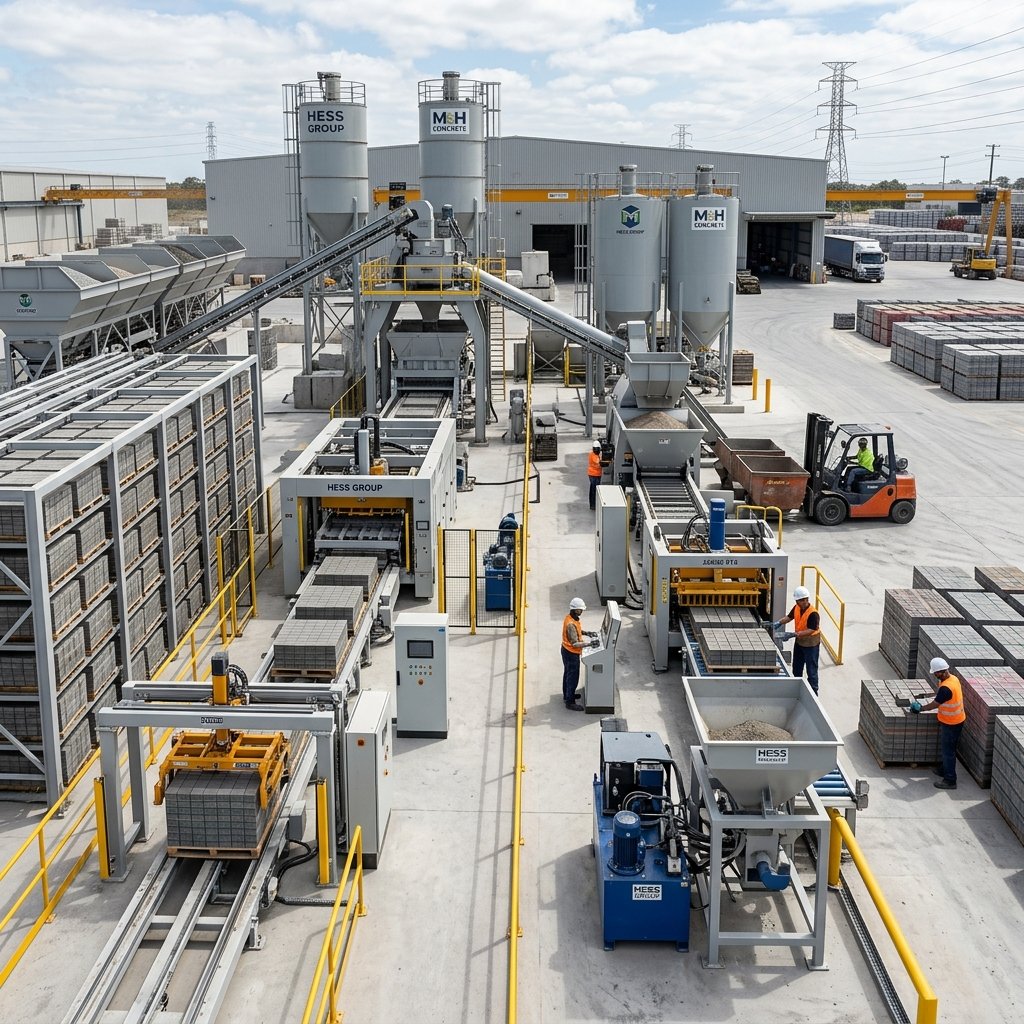
"If you are ready for growth, shifting from a 3,300 sqft/10,000 paver output to a 6,000 sqft/20,000 paver output isn't just about speed, it's about maximizing your margins per unit."
When setting up a wet cast concrete production line, choosing the right machinery is the most critical business growth strategy. Should you start with a cost effective semi automatic paver block plant 3300 sqft setup, or scale immediately with a high capacity automatic paver block plant 6000 sqft setup? The answer depends heavily on your capital resources, labor availability, and target B2B infrastructure demand in regions like Maharashtra, Pune, and Gujarat.
Understanding the Scales of Production
Let's look at the numbers. A semi automatic paver block plant 3300 sqft capacity per shift yields approximately 10,000 blocks. This setup relies on manual labor for raw material handling, pigement feeding, and stacking, requiring about 10 to 15 workers. It is highly affordable with a lower entry barrier, making it the perfect starting point for new entrepreneurs.
Conversely, a fully automatic paver block plant 6000 sqft capacity yields up to 20,000 paver blocks per shift. It integrates automated PLC batching systems, planetary concrete mixers, and automatic pallet handling. It dramatically cuts manual labor requirements down to only 8 to 10 workers, eliminating batch inconsistencies and concrete wastage.
Automation brings unprecedented control over your raw material inputs. In a semi-automatic setup, laborers physically measure and add cement, sand, and aggregates into a pan mixer. Human error inevitably leads to inconsistent batches—one batch might be too wet, another too dry. A fully automatic plant uses load cell-equipped batching plants that measure materials down to the gram. This precision ensures every single paver block leaving your factory meets strict M30 or M40 compressive strength standards.
Let's talk about the mixing technology. Semi-automatic plants usually employ standard pan mixers. These are effective but rely on a single rotating axis. Fully automatic plants utilize planetary mixers. A planetary mixer operates like a celestial system—the mixing stars rotate on their own axes while revolving around the center of the pan. This dual-action motion ensures 100% homogenous mixing in half the time, crucial for dispersing color pigments evenly and activating the cement particles fully.
The return on investment (ROI) is determined by two main factors: daily operating costs and market price per square foot. While fully automatic plants have higher upfront setup costs, their operational efficiency yields a much higher profit margin per block:
- Labor Efficiency: Automatic plants cut labor expenses by 30 to 40% per shift while doubling the volume.
- Material Consistency: Automated batching scales aggregate and cement ratios precisely, preventing cement wastage.
- Planetary Concrete Mixer Advantage: High performance planetary mixers ensure a 100% homogenous concrete blend, boosting block compressive strength and allowing manufacturers to sell premium grade pavers.
Furthermore, scaling your business involves looking at your utility costs. An automatic plant, while requiring more electrical load in terms of connected kilowatts (kW), often processes material faster. This means the energy consumed *per block* is frequently lower than in a semi-automatic setup that runs longer to produce the same volume. Optimized vibration times on automatic high-frequency vibrating tables ensure rapid compaction, further saving energy and time.
Stack curing is another area where automatic plants excel in workflow design. With automatic pallet stackers, the cured blocks are moved seamlessly to the curing racks without manual intervention. This reduces handling damage—a major source of rejected blocks in semi-automatic setups where workers manually lift heavy, semi-cured blocks.
The choice between semi and fully automatic also dictates your target market. A semi-automatic plant producing 10,000 blocks a day is perfect for local residential projects, small municipal walkways, and private driveways. However, if you aim to bid for heavy-duty infrastructure projects—like toll plazas, industrial factory floors, or large-scale government highway beautification projects in Maharashtra—an automatic plant is a prerequisite. Government tenders often require strict quality control documentation, which a PLC-controlled automatic batching plant can export directly.
Civil Layout and Space Footprints: Setting up these systems requires careful spatial planning. A semi-automatic plant requires a footprint of approximately 3,300 sqft, which mostly consists of open yard space for manual aggregate storage and hand-curing ponds. A fully automatic 6,000 sqft setup, however, utilizes a highly structured layout with pits for the aggregate batching bins, elevated platform structures for the planetary mixer, and rail tracks for automatic stacking trolleys, allowing vertical yard space optimization.
Electrical Connected Load and Utility Costs: Energy management is another differentiating factor. While a semi-automatic unit runs on a total connected load of 15 to 20 HP (powering a pan mixer, belt conveyor, and simple vibrating table), a fully automatic turnkey plant runs on a 45 to 60 HP system. This requires installing a dedicated 63 kVA transformer and an Automatic Power Factor Correction (APFC) panel to optimize electricity consumption under industrial tariffs in Maharashtra.
Modular Growth Options: Manufacturers starting on a limited budget can choose a modular path. You can initialize operations with a Balaji semi-automatic plant and incrementally add aggregate batching bins, PLC recipe controllers, and pneumatic auto-ejection mechanisms later. This allows regional concrete block manufacturers in Pune, Nashik, or Satara to scale their capital expenditure in alignment with their business growth.
To conclude this comprehensive analysis, the decision rests on your capital allocation strategy. The semi-automatic route offers flexibility, lower risk, and a gentle learning curve for those new to the concrete industry. The fully automatic route is a heavy-hitting, aggressive growth strategy designed to dominate regional supply chains through sheer volume and undeniable quality consistency. Assess your market demand, secure your capital, and build the foundation for a highly profitable paver block manufacturing business.
Which Investment Fits Your Business Scale?
If you are an entry level entrepreneur looking to serve local construction dealers, starting with an affordable semi automatic system provides a safe, low risk ROI. It allows you to build a customer base and learn the operational dynamics of concrete casting without heavy debt. However, if you are targeting governmental contracts, high load industrial highways, or large B2B commercial developers near Pune, Satara, or Mumbai, the fully automatic plant is the superior investment to secure the production capacity required for large scale operations. The automatic plant's capability to deliver high-volume, certified-strength blocks consistently is key to winning large contracts.